

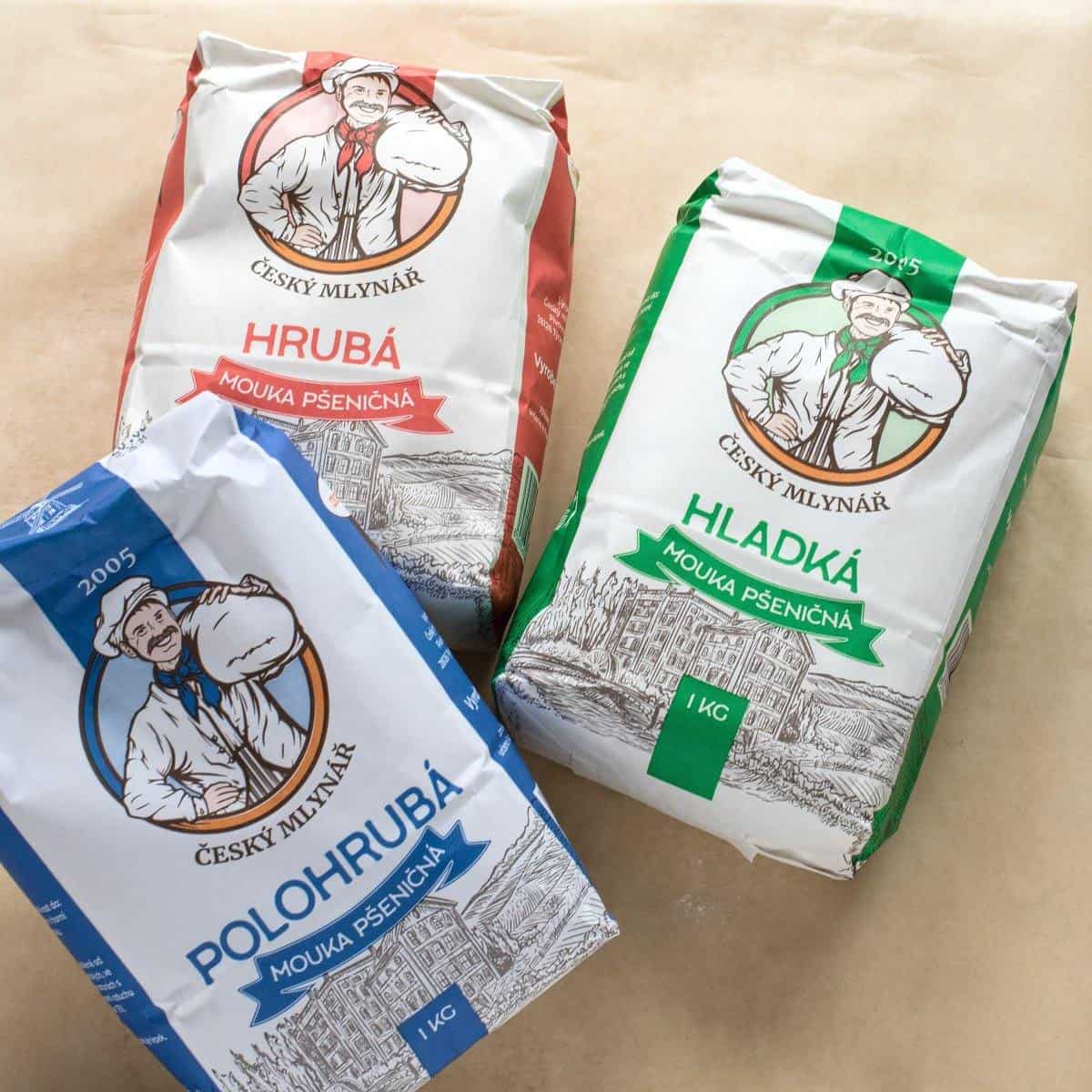
Czech home bakers most often bake with wheat flour. If you look around in Czech shops, you will find that wheat flour usually comes in three varieties, referred to as Hrubá (coarse), Polohrubá (semi-coarse), and Hladká (smooth).
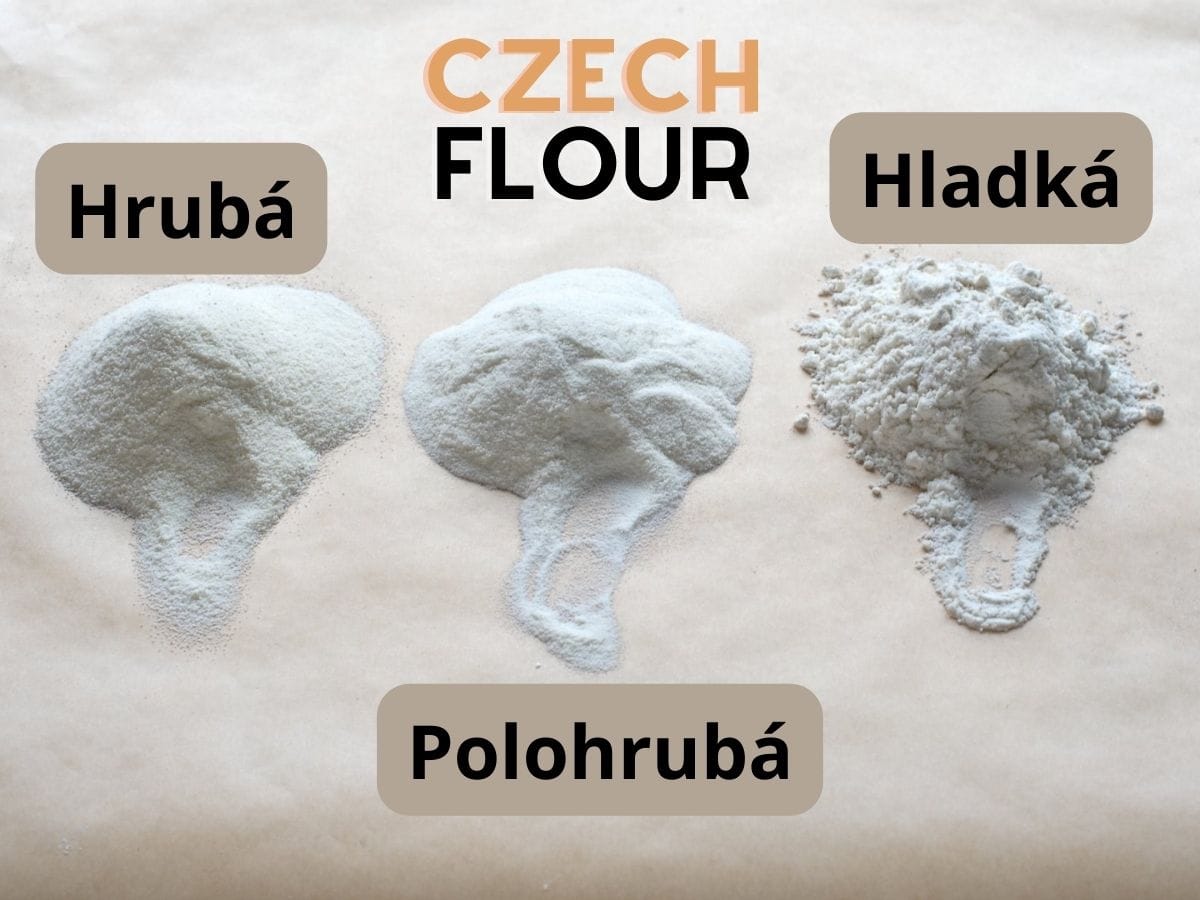
As you may have guessed, this is the basic classification of wheat flour based on the fineness or coarseness of its particles.
In Czech recipes, the type of flour is indicated in the list of ingredients. But what if you live in the USA and would like to try one of the appealing Czech pastries? What flour should I use when the vast majority of recipes in the US call for all-purpose flour?
Let me explain it further.
➜ Hladká mouka
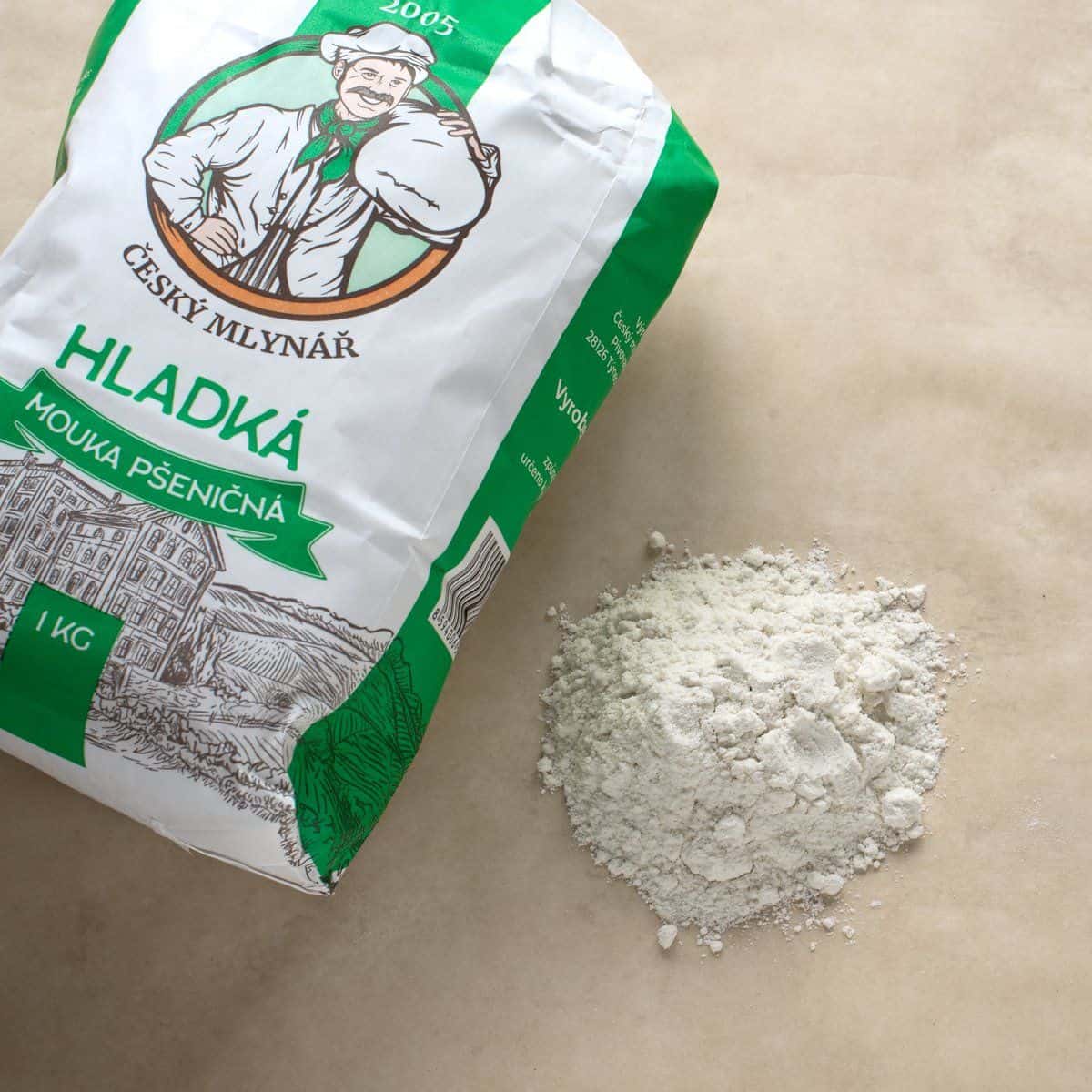
Czech Hladká mouka is a smooth wheat flour with a high gluten content, making it an excellent choice for cakes or yeast doughs for Kolache and Buchty. It is also used for velvety Palačinky pancakes and for thickening sauces with roux.
Doughs made with this fine flour rise quickly and evenly, resulting in soft and fluffy baked goods.
Hladká mouka is a common type of flour in Czech cooking that has a wide range of uses. It is the closest equivalent to all-purpose flour used in the US or Canada. If you are based in the United Kingdom or Australia, substitute Czech Hladká mouka with plain flour.
➜ Polohrubá mouka
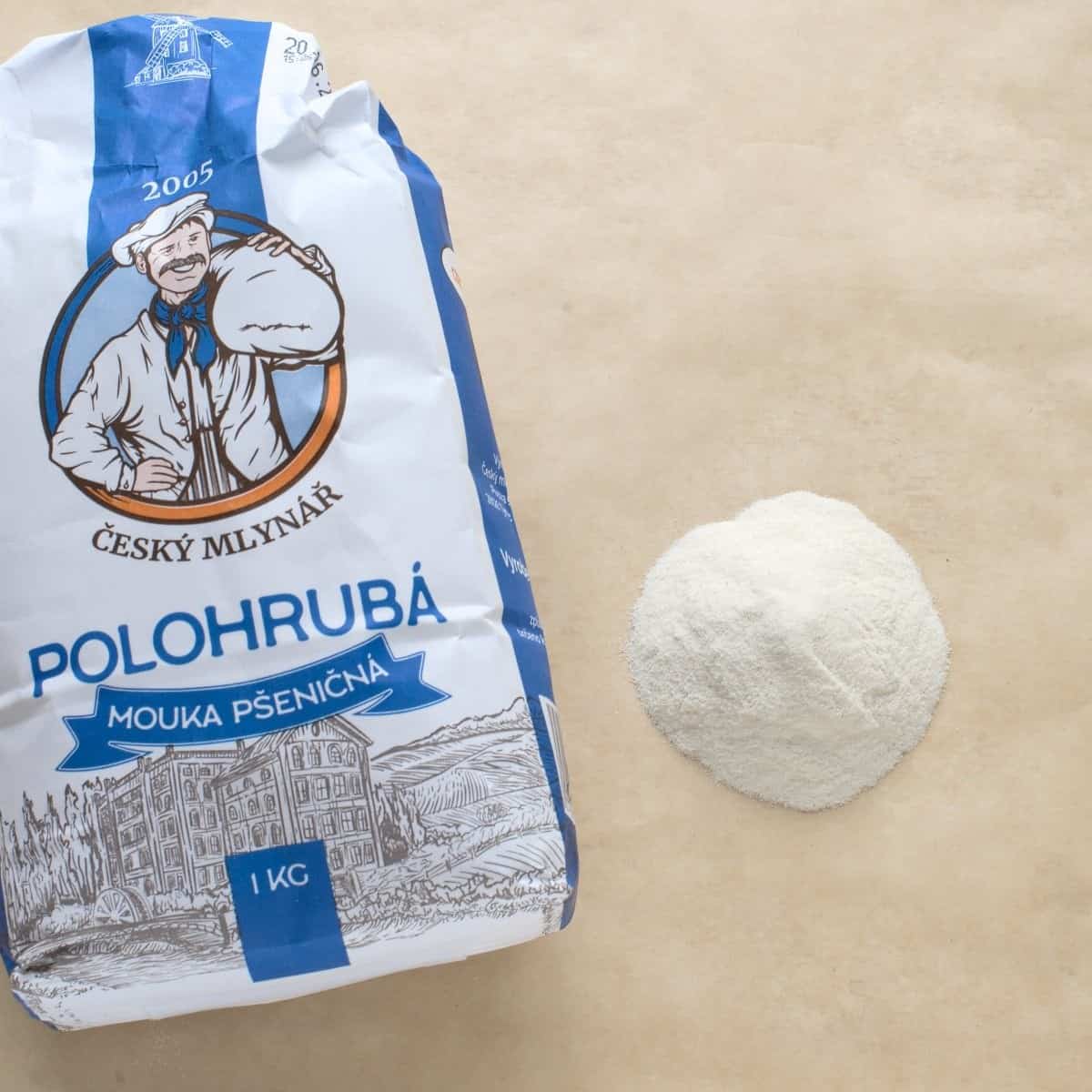
Polohrubá mouka (semi-coarse) is a Czech specialty developed by millers to meet the demands of enthusiastic Czech bakers. As the name suggests, semi-coarse flour is made from coarser-ground grains.
TIP: One of the nice things about Polohrubá is that it tends to form fewer lumps during cooking than AP flour.
Polohrubá is often added to Hladká mouka to improve the quality of the pastry, such as texture and shelf life. Polohrubá flour is most commonly used in the production of sheet cakes with a runny batter-like dough, such as the Czech Bublanina cake. It finds frequent use in preparing crumby Posypka topping but is also employed in fruit dumplings (ovocné knedlíky).
A possible replacement for Czech Polohrubá mouka in the USA is Wondra flour.
➜ Hrubá mouka
When preparing Czech recipes, I am often asked about this particular type of flour.
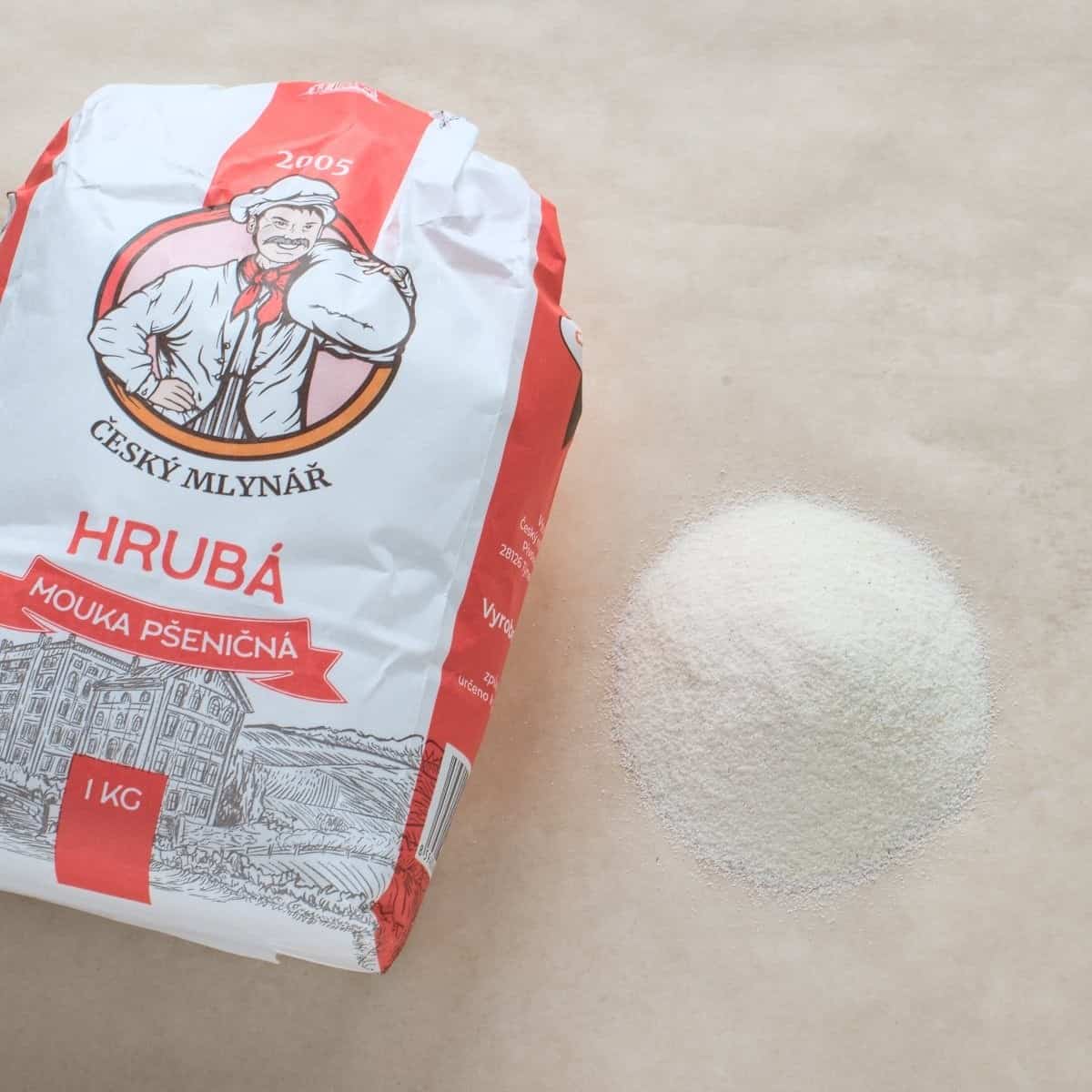
Czech Hrubá mouka has a much coarser texture than all-purpose flour and is typically used in dishes that need to be boiled, such as traditional Czech dumplings, whether they are bread dumplings (Houskové knedlíky) or potato dumplings (Bramborové knedlíky). Other examples of Czech recipes using coarse flour are Šišky or Škubánky.
Finding a direct substitute for Czech coarse flour in the US may be difficult. Hovewer, you can easily substitute it by adding fine semolina or cream of wheat (Czech Krupička) to all-purpose flour, roughly in the ratio of 1 part semolina to 2 parts all-purpose flour.
Did you know that the three basic types of Czech flour can be easily identified thanks to color markings? Hladká is green, Polohrubá is blue, and the package of Hrubá flour is labeled red.
➜ Czech flour around the world
Finding the right flour for your recipe can be quite a challenge! I've asked my community around Czech recipes, who live abroad and have experience with Czech flour, to lend a hand in recommending the best replacements for each type of flour.
My people have been incredibly helpful and provided me with answers that I think will also be beneficial to you. I have put together a table for you with the types of Czech flour and their substitutes in the USA, Canada, Australia, and the UK.
The bottom row shows Polish flour, and just below the table, I will explain why you might find this information interesting!
| CZ | Hladká | Polohrubá | Hrubá | Krupička |
| U.S. | All-purpose | Wondra | Mix of AP flour + Wondra/Cream of Wheat | Cream of Wheat |
| Canada | All-purpose | Robin Hood blending flour | Mix of AP flour + Semolina | Semolina |
| Australia | Plain | Continental flour | Continental sharps flour | Semolina |
| U.K. | Plain | Strong bread flour | ||
| Polish | Mąka luxusowa | Maką tortowa | Mąka Krupczatka | Kasza manna |
The magic of Polish flour lies in the fact that Polish communities abroad often run shops selling Polish food. These shops also offer flours very similar to those used in Czech cuisine.
So if you are looking for a substitute for Czech flour abroad, see if there is a Polish deli nearby. Using the information from the last row of the table, you can easily choose the right flour for your culinary adventures!
➜ More interesting flour facts mentioned by my readers
Here are a few more tidbits about flour that are worth highlighting:
- Don't add extra work for yourself! All-purpose flour can be used for everything, from baking cakes to thickening sauces. You can even make Czech dumplings with AP flour, seriously! It just takes a bit of patience and maybe a bit of practice.
- Wondra flour comes in a typical blue container. It is very similar to our Czech "Polohrubá," but costs considerably more than AP flour!
- People sometimes use cream of wheat/semolina mixed with AP flour or plain flour to achieve what they want to do with Czech Hrubá mouka. The basic rule of thumb is to mix ⅗ AP flour and ⅖ cream of wheat.
- In Australia and the UK, you'll often come across self-raising flour. Baking powder has already been added to this flour, so be careful with the recipe you want to make.
- In the Czech Republic, we use "Hladká" flour (similar to AP or plain flour) for thickening sauces. If the sauce needs to be gluten-free, use arrowroot, corn starch/potato starch, or corn flour instead.
Important note: Keep in mind that each type of flour weighs and hydrates differently, so start with a smaller amount than your recipe calls for and add more as needed.
➜ Can I make Czech dumplings with all-purpose flour?
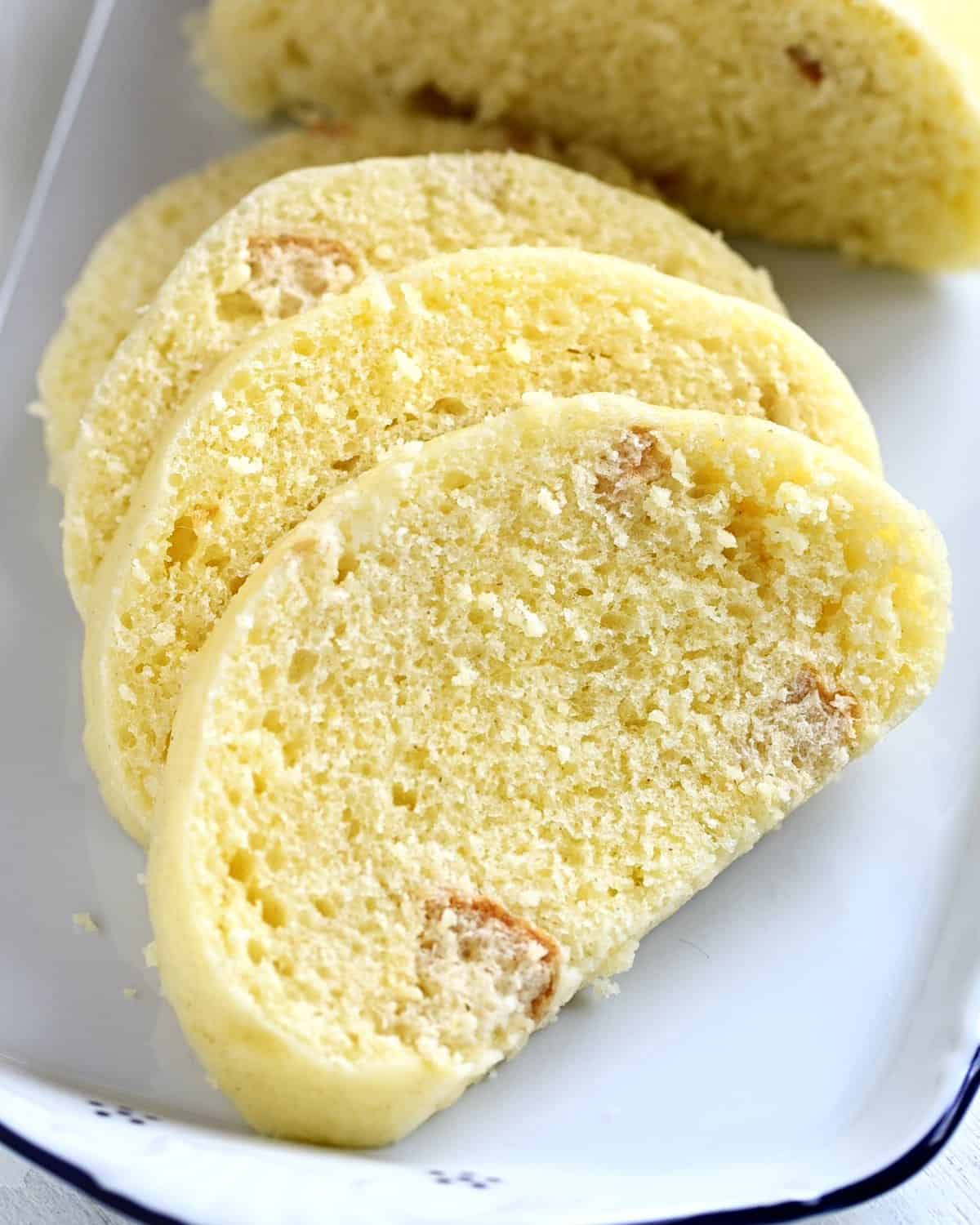
First of all, I must mention that dumplings are one of the most iconic Czech foods. Many Czechs abroad wonder what kind of flour to use since traditional dumplings are made with Hrubá coarse flour.
I can assure you that you can easily make Czech dumplings with all-purpose flour (tested many times with Czech Hladká flour). Dumplings made with all-purpose flour will be soft and airy, but with a less coarse texture. The flavor will be fantastic, no worries.
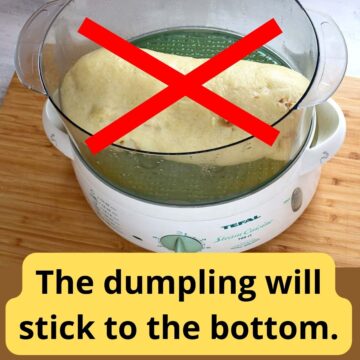
MY TIP: I recommend steaming Czech dumplings instead of boiling them in water. They will be evenly cooked and more visually appealing.
Now it's your turn-if you live outside the Czech Republic, what are your experiences with flour? Please let me know in the comments which flour you use and in which country. I will be happy to add your insights to the article about Czech flour!
Ludmila says
In the USA i make knedliky from Vondra. They have better texture, not very soft like from all purpose flour.
Thank you for your recipes. You are very good with your direction and notes. Keep a good work. Thank you.
Zdeněk says
Hi Petra
What are the UK equivalents for the Czech flours please? You mention that hladká mouka is plain flour, but what about the others (i.e. polohrubá and hrubá)?
Many thanks
Zdeněk
Louis says
Thank you for such wonderful recipes. I generally use an all purpose flour made of soft winter wheat. Your hints are greatly appreciated, especially about steaming bread dumplings instead of boiling. Also, adding "cream of wheat" to the flour to duplicate the coarser Hruba'.
Brenda says
Thank you, Petra. Here in the UK I have used plain flour combined with semolina in the ratio you suggest ever since my father taught me to make knedliky in the 1950s. Which he, of course, learned from his mother. We always boiled them but I have tried your suggestion of steaming and I like the results.
Charalyn says
I live in Canada. For years I made dumplings with Robin Hood Instant Blending Flour, baking powder and croutons. Now I make hem with All Purpose flour and yeast, no crouton. It’s a never fail recipe ( will post later). I always boil them because I do not have a proper sized steamer and have had bad luck with dumplings sticking to steamer basket. I would appreciate tips on how to steam dumplings, the large oblong ones) and the type of equipment used. Gentle boiling works for me but I think that steaming would be easier. And I always cut my dumplings with a thread. I often make double batches of dumplings using up milk that is about to go sour and store them in the freezer.
Anicka Cooklikeczechs.com says
Ahoj Charalyn, thank you so much for your feedback!
Greetings from the Czech Republic.
Katya says
"It’s a never fail recipe ( will post later)."
famous last words? lol
did you? will you?
where do I find it?
Ted says
try cooking the dumplings in silicone loaf form (sprayed with oil), semi submerged in boiling water in a covered pan. Wrong shape but totally foolproof.
Zuzana says
I live in Australia. I use what's called 'Continental Sharps Flour' when making knedliky. Ingredients: unbleached wheaten flour & fine semolina. I have always boiled my dumplings & cut them with what looks like a giant egg slicer. Beats cutting with thread like my mother did. Love your website. Ahoj
Anicka Cooklikeczechs.com says
Thank you for your comment and feedback, Zuzana. I appreciate your kind words.
Jana says
Here in US I use all-purpose flour for almost everything, but for knedliky I use Vondra flour.
Anicka Cooklikeczechs.com says
Thank you for your comment, Jana!
Penny de Vries says
We basically have three types of flour in the small southern town I live in. All purpose flour which most people use. We also have bread flour which has a higher protein content for breads. And finally, we have self-risen flour that contains salt and baking powder. I love to make pasta and pizza so I order 00 flour from Italy on Amazon.
Anicka Cooklikeczechs.com says
Thank you for your feedback, Penny!
Charles Balcarek says
Hi Petra,
Here in Tasmania you can get whats called Continental flour, but its expensive and not that easy to find, depending on where you live. Ive done a few experiments and have come up with a ratio of 1 part semolina to 2 parts plain flour (any type), and for those yummy svestkovy knedliky i throw in a cup and a half of ready made mashed potato that you find in the fridges at the supermarket. i was brought up in vysoke myto on comfort foods like merunkovy knedliky and sladka rejze and svickova, and off course the all time boiled semolina in milk (bit like porridge without the lumps. Now in my 60's, i still crave for the same comfort foods. Am making ovocne knedliki with bananas and various fruits and they are devine!.
love your recipes and easy explanations...you are like a breath of fresh air, thank you.
Anicka Cooklikeczechs.com says
Thank you so much for your comment and kind words, Charles!
Milena says
wow thank you very much for this information. hrubá mouka I think only in Czech Republic or Europe, in us have never seen. polohrubá is Vondra which about 20 years ago still was selling in 5 lb bags now these days you can get it I think 1 lb container and you're lucky if you find it. I will definitely do the combination. again thank you very much for the information. by the way love your website. Will definitely check out your YouTube Channel
Anicka Cooklikeczechs.com says
Thank you for your comment and feedback, Milena.
Hope you will enjoy the videos too! 🙂
Marketa says
Hi, just to note Polohrubá mouka does not quite exist in the UK, it is not Strong bread flour, that is a special flour for making bread (has more protein content). Polohruba mouka can be bought in Polish shops.
Petra Kupská says
Thank you for the clarification!
Lenka Zuvac says
Je mozne si tuto mouku objednat z USA?
Petra Kupská says
Myslím, že například zde by českou mouku mohli nabízet: https://www.slovczechvar.com/?lang=en
Kamila says
Yes, there is a online store http://www.slovczechvar.com that sells Czech/Slovak foods, flour, Vinea, Kofola, etc. but the shipping is high b/c of the weight of the goods.
I order only about once a year as it's cost prohibitive.
https://www.slovczechvar.com/products/flour-wheat-gross-vitaflora-psenicna-mouka-hruba
Dani says
Thank you for listing the Polish equivalents of the flours! It's very helpful. I live in Canada, and found a local shop that sells a variety of different Polish flours 🙂
Petra | Cook Like Czechs says
You are welcome! I am so glad you find it helpfull. 🙂
Amy Cowell says
I loved your recipes. I have a gluten free restaurant in Chicago and I have tried some of your recipes with King Arthur gluten free all purpose flour and it works very well. I love seeing your recipes but they make me miss Prague and my family so much! Thank you!
Petra Kupská | Cook Like Czechs says
Thank you so much for your kind words! I am happy to hear that the recipes worked well with gluten-free flour. I can understand how seeing these recipes might bring back memories of Prague and your family. I hope they help keep that connection alive, even from afar. Best of luck with your gluten-free restaurant in Chicago, and I am so happy you’re enjoying the recipes!
Jeanette says
My family has a fruit dumpling recipe that has been passed down for 4 generations in the US. I always wondered why it calls for Farina or Cream of Wheat! Thank you for explaining this!
Petra Kupská says
This makes me so happy, four generations of fruit dumplings! Here is the why behind the Farina. In the Czech Republic we traditionally use coarse flour, hrubá mouka, for dumplings of every kind, sweet and savory alike. It is hard to find abroad, and every country has its own substitute: in the US, people often mix Farina or Cream of Wheat with all-purpose flour to get that coarseness. That said, you can make lovely dumplings with plain all-purpose flour too, what we call hladká mouka. Thank you for sharing your family's tradition.
Ivana Pelnar says
I have been stocking on Robin Hood Blending flour during trips to Canada since Wondra stopped selling their flour in multi-pound packaging. It sometimes makes for an interesting luggage search at the airport!! Dumplings made with AP flour, in my experience, are best boiled "v ubrousku" = in a cotton kitchen towel. One needs a large wooden spoon that fits across the top of the pot with boiling water, dough is placed in the towel, ends of towel tied to the spoon and the dumpling is carefully submerged. The towel on a spoon keeps it from falling to the bottom of the pot and ensures an even boil in the surrounding water.
Petra Kupská says
Thank you for sharing your tip, that’s a fantastic! I love the idea of using a cotton towel ‘v ubrousku’ to keep them from falling apart and ensure an even boil. It is great that you share these tips not only with me, but everybody. Haha, when you buy flour in these great amounts, you mean bussines! Happy baking!
Paul:-) says
Hi Petra & Anicka,
I have shied away from making dumplings because I couldn’t find the flour. I now have a 500g bag of finely ground Semolina. What ratio should I use with plain flour (uk)? I really am looking forward to making many types of dumplings now I have the correct flour.
Thankyou.
Paul:-)
Petra Kupská says
Paul, wonderful, now you are ready for dumplings! Use about one part fine semolina to two parts plain flour (what Americans call all-purpose flour). That gives you the coarser texture the dough needs without being heavy. Have fun, there are so many kinds to try.