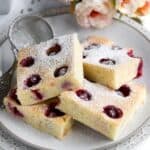
Bublanina – Czech Fruit Sheet Cake
When summer fruits ripen in June, it is bublanina time in every Czech kitchen! This traditional Czech sheet cake, with its soft sponge and pockets of juicy fruit, is simple enough for any baker to enjoy making at home.
Servings 12 slices
Calories 245kcal
Ingredients
- 3 cups fresh strawberries smaller pieces
- 3 medium eggs at room temperature
- 1 cup granulated sugar
- 2 ¼ cups all-purpose flour
- 1 teaspoon baking powder
- 1 cup heavy cream fat content over 30 %
- 1 Tablespoon lemon zest freshly grated
Misc.:
- ½ Tablespoon butter to grease the baking dish
- 2 Tablespoon fine breadcrumbs or flour to dust the baking dish
- 2 Tablespoons powdered sugar to dust Bublanina before serving
Instructions
- Wash 3 cups fresh strawberries gently under cold running water. Hull them by removing the green tops, then leave them in a colander to drain.
- Grease a baking tray with ½ Tablespoon butter or a drizzle of oil, then dust it with 2 Tablespoon fine breadcrumbs or flour. Alternatively, line the tray with parchment paper.
- Crack 3 medium eggs, warmed to room temperature, into a large mixing bowl. Using a hand mixer fitted with the whisk attachment, beat the eggs until foamy. Gradually add 1 cup granulated sugar while increasing the speed. Continue beating for about five minutes, until the mixture is pale, thick, and fluffy.
- Reduce the mixer speed to the lowest setting. Gradually add 2 ¼ cups all-purpose flour mixed with 1 teaspoon baking powder, along with 1 cup heavy cream, into the beaten egg foam. Stir continuously until just combined, then fold in 1 Tablespoon lemon zest.
- Pour the smooth, semi-liquid batter onto the prepared baking sheet and spread it evenly. Pat the strawberries dry, toss them lightly with a tablespoon of flour, and scatter them generously over the top.
- Place the bublanina in an oven preheated to
 340 °F, using both upper and lower heat. Bake for about 30 minutes, or until the surface turns a light golden brown.
 - Allow the bublanina to cool completely, then dust with 2 Tablespoons powdered sugar. Cut into squares of about 4 inches (10 cm) and serve with a cup of freshly brewed coffee or tea.
Notes
- The basic recipe makes about 12 pieces (fits into a 9x13 inches baking pan).
- Serve at room temperature. Allow the bublanina to cool completely, dust with icing sugar, and cut into squares. Pair with a cup of freshly brewed coffee or tea.
- Store in a cool spot or in the fridge. Keep the bublanina covered in the baking dish in a cool spot for up to two days, or transfer slices to an airtight container in the fridge for up to five days.
- Freeze for longer storage. Cool the cake completely, then cut into slices and arrange them in a single layer in an airtight container or freezer bag, with parchment paper between layers if stacked. Freeze for up to three months and thaw at room temperature before serving.
- Keep the fruit from sinking. Pat the fruit dry, then toss it lightly with a tablespoon of flour before scattering it over the batter. The thin coating helps the pieces stay near the top.
- Choose fresh or frozen fruit, not canned. Use fresh berries when they are in season, or frozen fruit straight from the freezer. Canned fruit holds too much liquid and can make the sponge soggy.
Nutrition
Calories: 245kcal | Carbohydrates: 40g | Protein: 5g | Fat: 8g | Saturated Fat: 4g | Polyunsaturated Fat: 1g | Monounsaturated Fat: 2g | Trans Fat: 0.04g | Cholesterol: 60mg | Sodium: 70mg | Potassium: 113mg | Fiber: 1g | Sugar: 20g | Vitamin A: 312IU | Vitamin C: 22mg | Calcium: 47mg | Iron: 2mg